Even if you don’t buy a Chinese-branded car, you are likely driving Chinese technology.
How China’s EV Technology Took Over the Auto World
By Zvakwana Nomore Sweto
For over a century, the global auto industry danced to a German beat with an American soundtrack, powered by a Japanese-engineered engine. The internal combustion engine was king, and the throne was in Detroit, Wolfsburg, and Tokyo.
Today, the tectonic plates of the automotive world have shifted decisively toward the East. China, long dismissed as a copycat manufacturer, has not just entered the electric vehicle (EV) race, it is lapping the competition. From battery chemistry to in-car AI, smart manufacturing to supply chain logistics, China’s EV technology is no longer a rising star; it is the sun, and the rest of the world is only now waking up in its light.
Any EV is only as good as its battery. And China owns the kilowatt-hour.
Contemporary Amperex Technology Co. (CATL) and BYD are not just suppliers; they are the gatekeepers of modern electromobility. CATL alone controls over 37% of the global EV battery market, powering Teslas, Fords, BMWs, and Volkswagens. Meanwhile, BYD’s revolutionary Blade Battery has set a new global standard for safety, passing nail penetration tests that cause other batteries to explode.
Where Western rivals are scrambling for lithium and cobalt, Chinese firms have locked in long-term mining rights across Africa, South America, and Australia. They have also leapfrogged current tech by mass-producing cheaper, more energy-dense sodium-ion batteries, freeing themselves from supply chain vulnerabilities that still haunt Europe and North America.
A decade ago, Chinese EVs were golf carts with doors. Today, vehicles from brands like Nio, Xpeng, and Zeekr are technological marvels that out-innovate legacy automakers on features that matter to digital-native drivers.
Consider the Nio ET7. It boasts a 1,000-kilometer range (on the Chinese CLTC cycle), swappable batteries that exchange in under three minutes, and a suite of autonomous driving sensors including ultra-long-range Lidar. Then there is the BYD Yangwang U8, a luxury SUV that can float on water and turn like a tank using four independently controlled electric motors.
While German and Japanese automakers are still debating software update strategies, Chinese EVs ship with operating systems that integrate your phone, home appliances, and social media into a seamless cockpit experience. They don’t just drive you; they anticipate you.
The most devastating weapon in China’s EV arsenal is cost.
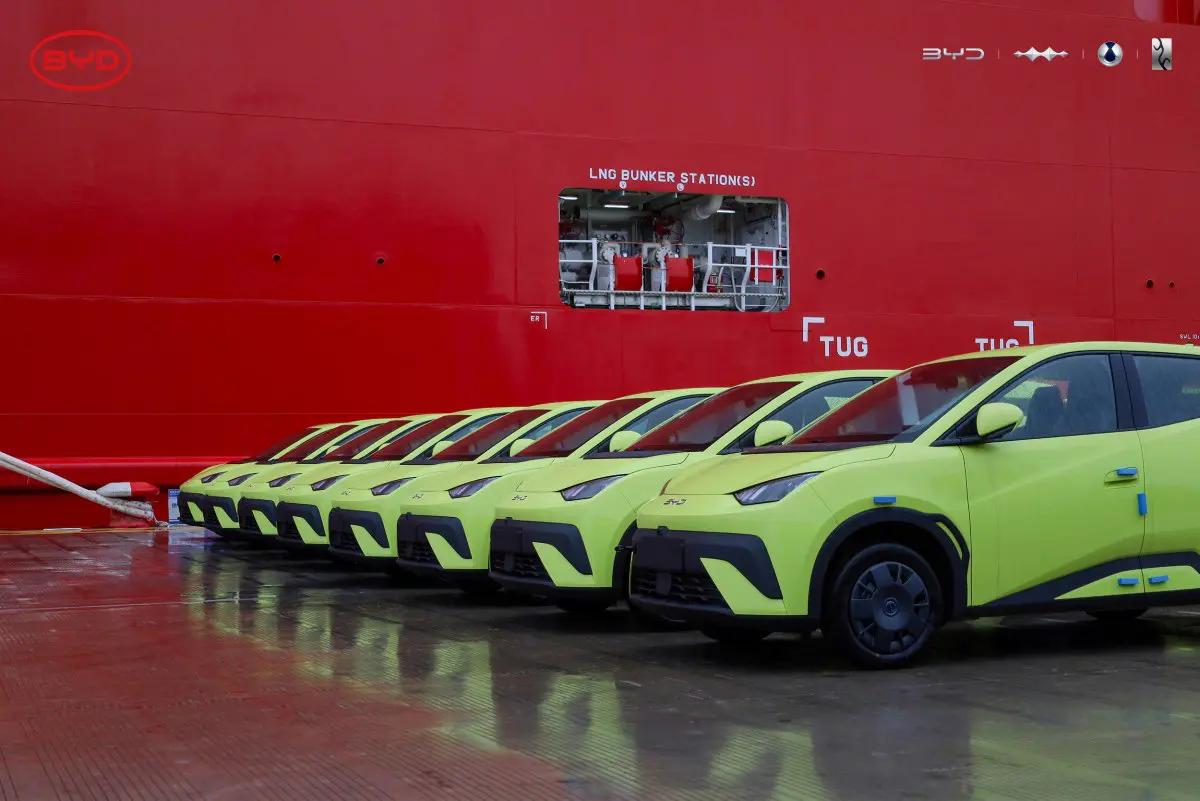
Thanks to a hyper-competitive domestic market, the largest on Earth, and government subsidies that have been strategically phased into self-sustaining scale, Chinese automakers can produce high-quality EVs for a fraction of the cost of Western rivals. The BYD Seagull, a compact EV, retails for under $11,000 in China. No Western automaker can match that price without bleeding cash.
When Chinese EVs arrive in Europe, they undercut local offerings by thousands of euros while offering more standard tech. The EU has launched anti-subsidy investigations, and the U.S. has slapped high tariffs on Chinese EVs. But protectionism is a slow tourniquet, not a cure.
Even if you don’t buy a Chinese-branded car, you are likely driving Chinese technology. Volkswagen now partners with Xpeng. Stellantis co-owns Leapmotor. Ford uses CATL batteries. Volvo and Polestar? They are essentially Chinese-owned.
China has built an EV ecosystem so dense and efficient that it is nearly impossible to assemble a competitive electric car without touching Chinese components, from electric motors and thermal management systems to the rare earth magnets in the wheels. Attempts to build “China-free” supply chains have proven exorbitantly expensive and slow.
The Challenge
Dominance is not destiny. China’s EV juggernaut faces headwinds: oversupply at home leading to brutal price wars, rising trade barriers in Western markets, and lingering brand perception issues where “Made in China” still carries unwanted baggage among older consumers.
Moreover, the next battleground, solid-state batteries and fully autonomous driving is wide open. Japan’s Toyota and America’s Tesla are investing heavily to reclaim technological leadership.
But for now, the center of gravity in the auto world has unmistakably moved. The Detroit auto show is a nostalgic footnote; the IAA in Munich has become a showcase for Chinese brands. When the history of 21st-century transportation is written, it will note that while legacy automakers were refining the past, China was quietly, efficiently, and relentlessly building the future.
The engine may have changed, but the driving force is now Chinese. And the rest of the world is still trying to figure out how to catch up.