The better question is, “Can this system reflect the way our projects are delivered, costed, billed, changed, and controlled?”
The Practical Guide to Choosing a Construction ERP in the UAE

By Atif Rehman in Dubai, UAE
Most ERP pain in UAE construction does not come from software alone. It comes from the gap between how the system is designed and how projects actually make money.
A generic ERP can usually handle accounting, purchase orders, invoices and general reporting. That is useful. But construction needs more than that.
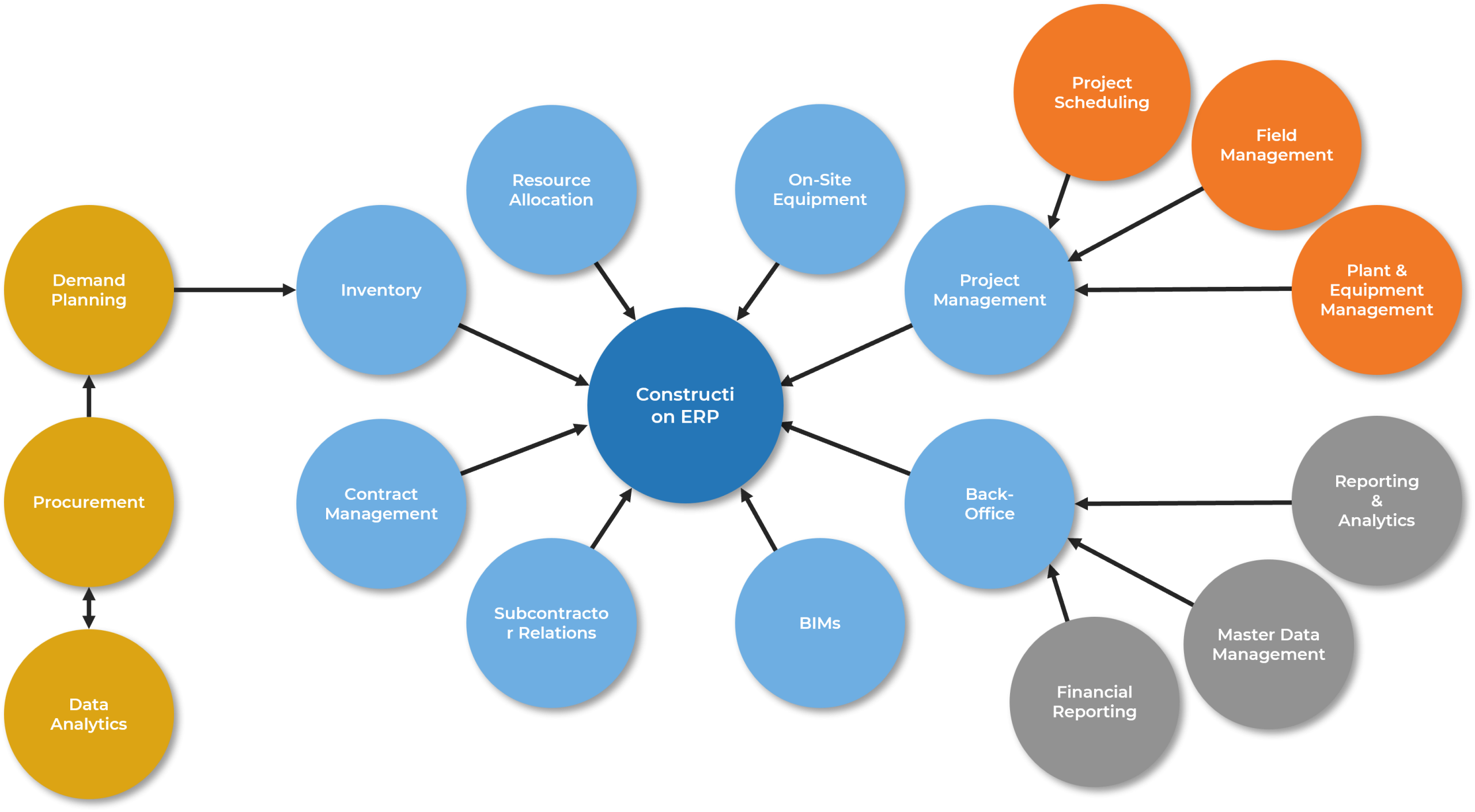
Contractors need to manage job costing, progress billing, variations, subcontractor claims, retention, WIP, approvals, document control, payroll, compliance and cash flow by project. If the ERP cannot support that reality, teams will create workarounds. And once the workarounds begin, control starts to weaken.
In the UAE, this matters even more. The construction market remains large, complex and active, with the UAE construction market estimated at USD 127.13 billion in 2026 and forecast to reach USD 167.27 billion by 2031. Growth is expected across residential, commercial, infrastructure, energy, and utility projects, but cost pressure and execution complexity remain real concerns. Modor Intelligence
So the question is not simply, “Which ERP should we buy?”
The better question is, “Can this system reflect the way our projects are delivered, costed, billed, changed, and controlled?”
That is the real test.
Start with how your projects make money
ERP selection often starts in the finance department. That makes sense, but it is not enough.
In construction, finance is connected to everything happening on the project. A cost code entered late affects job costing. A variation approved outside the system affects margin. A subcontractor claim certified without proper backup affects cash flow. A delayed billing application affects collections.
Before choosing a construction ERP, contractors should map the commercial flow of the business.
How do projects generate revenue? How is progress measured? How are interim payments certified? How are variations approved? How is retention tracked? How are subcontractor claims controlled? How does leadership know whether a job is gaining or losing margin?
If the ERP cannot answer these questions clearly, it may work as accounting software, but it will struggle as a construction control system.
This is where construction-specific ERP becomes important. It should not force project teams to translate construction activity into generic finance language. It should already understand the way projects work.
Job costing should be live, not monthly
Job costing is one of the biggest areas where generic systems fall short.
Many contractors only get a clear view of project cost after the finance department closes the month. By then, the project has moved on. Labor has been posted. Materials have arrived. Subcontractors have claimed. Variations have shifted the scope. The report may be accurate, but it is late.
In construction, late accuracy is still a risk.
A strong ERP should allow costs to be captured against the job as they happen. Labor, materials, equipment, subcontractor costs, purchase orders, commitments, and expenses should all flow into the project cost structure.
This gives project managers a live view of where they stand. It also gives finance fewer surprises at the end of the month.
At Premier Construction Software , job costing is not treated as a separate report. It connects to commitments, AP, AR, project billing, change orders, payroll, dashboards, and financial reporting. That means the project cost position is built continuously, not reconstructed later.
That distinction matters.
Billing must be tied to progress
In the UAE, billing is rarely simple. Contractors deal with payment applications, consultant certification, retention, advances, variations, back charges, and supporting documents. Clients and consultants expect traceability. They want to see what was completed, what was approved, what is billable, and what has already been claimed.
If billing is managed separately from project progress, problems start quickly.
The site team says work is complete. Finance does not have the backup. The consultant asks for clarification. The client delays certification. Cash flow slows.
This is not only a billing issue. It is a project control issue. A construction ERP should connect billing to progress, cost codes, approvals, and documentation. The billing application should not be assembled from emails, spreadsheets, and folder searches. It should come from the same system where the project is being managed.
Premier supports comprehensive project billing by keeping billing tied to job costing, approvals, documentation, and project activity. This helps teams reduce disputes, speed up certification, and give clients a clearer view of what is being billed.
In construction, cash does not slow down only because work is delayed. It often slows down because the work is not shown clearly enough.
Variations should not live in Excel
Variations can decide whether a project protects margin or loses it. This is especially true in the UAE, where design changes, client instructions, authority requirements, scope clarifications, and fast track delivery are common. If variations are tracked outside the ERP, leadership gets a distorted view of the job.
The problem is not only whether the variation is approved. The real issue is how it affects cost, revenue, billing, forecast, and subcontractor exposure. A proper ERP should track the full variation lifecycle. Initial event, Cost impact, Revenue impact, Approval status, Linked documents, Budget update, Billing impact, Subcontractor impact and Forecast update.
If this chain is broken, the project team may think the margin is protected while finance sees a different picture later.
Premier links change orders and variations into the project financial structure. This helps teams see the impact earlier and reduces the risk of lost entitlement or missed revenue.
AP and AR should feed job costing
AP and AR are often seen as back office processes. In construction, they shape project visibility. If AP invoices are posted late, job costing is late. If payments are not tied properly to project billing, cash flow visibility is weak. If supplier and subcontractor costs are not linked to the right jobs and cost codes, project managers are working with incomplete data.
This is why AP and AR should not sit apart from job costing. A construction ERP should connect supplier invoices, subcontractor claims, client billing, payments, retention, and cost codes. This gives finance and project teams a shared view of what has been committed, billed, paid, and collected.
This will also become more important as the UAE moves through its electronic invoicing rollout. The Ministry of Finance guidelines make it clear that businesses need to assess changes required in their ERP, accounting, and invoicing systems, integrate with accredited service providers where required, and ensure their systems can generate the necessary invoice data points.
That means ERP readiness is no longer only about internal reporting. It is becoming part of compliance readiness as well.
Premier’s accounting workflows are designed to keep AP, AR, job costing, approvals, and reporting connected. That matters because an invoice is not just a finance document. In construction, it is part of the project record.
Field data must reach finance quickly
A construction ERP should not stop at the office.
Many of the inputs that drive financial accuracy begin on site. Time entries, daily activities, safety records, photos, equipment usage, delivery records, and field expenses all affect project cost and progress.
If site data arrives late, finance is forced to work with partial information. If it arrives in the wrong format, someone has to clean it. If it never connects to the job cost structure, it becomes information without control value.
This is where mobile capability matters.
The UAE market is already moving toward more digitally integrated project planning, monitoring, and delivery. The US International Trade Administration notes growing demand in the UAE for digital construction technologies, including BIM, IoT applications, drones, 360 degree capture, and related construction technology tools.
A construction ERP should make field data useful, not just available.
Premier’s field and mobile capabilities support mobile time entry, daily activity tracking, employee expenses, safety inspections, and collaboration on drawings. The real value is not the mobile app by itself. It is the connection between what happens on site and what finance sees in the project numbers.
Dashboards are only useful if the data is clean
Dashboards are easy to sell. They are harder to trust.
A dashboard does not create control. It reflects the quality of the process underneath it.
If job costs are late, the dashboard is late. If variations are outside the system, the dashboard is incomplete. If billing is disconnected, the dashboard is misleading. If documents are scattered, the dashboard cannot explain the number.
This is why contractors should be careful when evaluating dashboards during ERP selection. A nice screen does not mean the system has discipline underneath it.
Ask where the dashboard data comes from. Ask whether it updates from live project workflows. Ask whether users can drill down from a KPI to the transaction behind it. Ask whether leadership can see risk across all projects without waiting for manual reporting.
Premier’s project KPIs and dashboards are built on connected job costing, billing, change orders, AP, AR, and project workflows. This helps leaders see not only what happened, but where attention is needed.
Internal controls matter more as you scale
As contractors grow, informal control becomes dangerous.
A small team can manage approvals through personal knowledge. A larger business cannot. Once you have multiple companies, projects, divisions, approvals, banks, subcontractors, and reporting layers, the ERP needs to enforce structure.
This includes approval limits, role based access, segregation of duties, audit trails, compliance records, vendor controls, and error prevention.
These controls are not bureaucracy. They protect margin.
For UAE contractors working across entities or preparing for larger developer, government, or infrastructure work, this becomes even more important. Clients expect professional governance. Auditors expect traceability. Finance teams need confidence that the system is not relying on memory.
Premier supports robust internal controls, segregated duties, approval workflows, vendor compliance, financial reporting, and unlimited company creation to help contractors scale without losing control.
Implementation is part of the decision
Choosing the ERP is only half the work.
The other half is implementation.
Construction ERP implementation is not just data migration. It is a redesign of how the business captures cost, approves work, bills clients, manages documents, tracks changes, and reports performance.
Before selecting a system, contractors should ask practical questions.
Who will own the implementation internally? Are our cost codes clean enough? Do we know which workflows need approval rules? What historical data do we need to migrate? How will finance and project teams be trained? What should go live first? How will adoption be measured after go live?
A good ERP partner should challenge the process, not just configure the software.
For Premier, implementation is not only about switching on modules. It is about aligning the system to how the contractor actually operates. That includes job costing structure, project billing workflows, approvals, document control, reporting, and finance processes.
ERP success is rarely won on launch day. It is won through the preparation before it.
What UAE contractors should look for
When evaluating a construction ERP, do not start with a feature checklist alone. Start with the business problems the system must solve.
A strong construction ERP should help you do the following:
- See job cost in real time • Connect billing to progress and approvals • Manage variations inside the project financial structure • Link AP and AR to job costing • Capture field data through mobile workflows • Maintain clean document control and audit trails • Support internal controls and segregation of duties • Prepare for electronic invoicing and compliance requirements • Provide dashboards based on live, trusted data • Scale across companies, projects, and regions
If the ERP cannot do these things, your team will fill the gaps manually.
And that is where the real cost begins.
Final thought
A construction ERP should not just record transactions. It should reflect how projects are delivered.
It should understand how contractors earn revenue, manage cost, recover variations, certify work, pay subcontractors, bill clients, and protect margin.
In the UAE, where projects move fast and expectations are high, this is no longer optional. Contractors need systems that keep up with the commercial reality of construction.
Because the right ERP does not only help you close the month.
It helps you control the project while it is still moving